
Use of Artificial Intelligence (AI) Scribes Demonstrates Decrease in Clinician Burnout
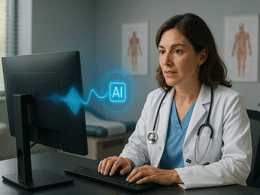 The evolution of electronic health records has contributed significantly to the administrative burden for clinicians. A recent study suggests the use of AI can reverse this trend.
As reported in JAMA, “While in short supply and high demand, ambulatory care clinicians spend more time on administrative tasks and documentation in the electronic health record than on direct patient care, which has been associated with burnout, intention to leave, and reduced quality of care.”
A study conducted in 2024 concluded that the use of an ambient AI scribe for 30 days was enough to demonstrate vast improvement in clinician burnout as well as improved quality of patient care and interactions. For more details, see the full article in JAMA.
The use of AI in healthcare is expanding rapidly, beyond the use of AI scribes. AI, a technology that simulates the performance of complex tasks (reasoning, solving problems, or making decisions) that normally require a human to perform, is rapidly transforming healthcare delivery. This technology is increasingly integrated into various healthcare applications from patient records management to diagnostic procedures. Some organizations have welcomed the technology, while others are taking a slower approach. It may surprise clinicians that they are probably already using AI indirectly through vendors who have incorporated various uses of AI into the products they offer. As AI becomes more commonplace, healthcare professionals and organizational leaders need to educate themselves and develop strong risk mitigation strategies to keep their patients and organizations safe from liability.
For more information, review our Practice Tip "Artificial Intelligence in Healthcare.“
This article falls under Technology in the Enterprise Risk Management (ERM) risk domains.
Technology
This domain covers machines, hardware, equipment, devices and tools, but can also include techniques, systems and methods of organization. Healthcare has seen an explosion in the use of technology for clinical diagnosis and treatment, training and education, information storage and retrieval, and asset preservation. Examples also include Risk Management Information Systems (RMIS), Electronic Health Records (EHR) and Meaningful Use, social networking and cyber liability.